How to Operate the Electrical Cabinet Profile Production Line Safely at Night
When the sun sets and factory floors quiet, night shifts for electrical cabinet profile production lines don’t just keep assembly moving—they support the tight turnaround times our clients rely on to get enclosures to their own customers on schedule. For years, I’ve walked alongside operators on our customer floors, troubleshooting at 2 a.m. and refining protocols that turn late hours into safe, productive work. If you run or manage one of these lines, you know night work isn’t just about turning machines on—it’s about designing a routine that protects your team, your equipment, and the profiles that will one day hold circuit boards, power systems, and critical infrastructure. Electrical Cabinet Profile Production Line

I still remember the first night shift at a client’s facility three years ago. Their lead operator, Jake, had worked graveyard for a decade and could run the line with his eyes half shut—but that night, he missed a frayed wire under the punching station. By the time the overheat alarm blared, the cable had melted enough to spark a small fire, injuring his hand and shutting down the line for 12 hours. That incident stuck with me. It’s easy to assume “experienced” means “safe,” but night shifts warp focus: ambient light is dimmer, circadian rhythms slow reaction times, and small oversights turn into big mistakes. Since then, we’ve worked with dozens of clients to tailor night-shift safety plans for their electrical cabinet profile lines—lines that cut aluminum, punch mounting holes, bend frames, and apply protective coatings, all while running on high voltage and heavy machinery. Below is what we’ve learned, grounded in real on-floor work, not just textbook checklists.
Start With the Shift Handover: The Non-Negotiable 15 Minutes
Night shifts don’t start when the first operator clocks in—they start when the day shift signs off. Most facilities skip this step, treating handovers as a quick “everything’s good” text. But electrical cabinet profile lines have moving parts that degrade, connections that loosen, and subtle warning signs that only someone who worked 8 hours on the line will catch. Our standard handover checklist, refined with Jake and hundreds of operators, includes three non-negotiable sections: equipment status, hazard logs, and task priorities.
First, equipment status isn’t just “the machine ran”—it’s specific. For a profile line, that means noting: the torque on the bending station’s die (did it drift 5 degrees during the day’s 500 bends?), the voltage reading on the cutting blades (was it spiking when trimming 12-foot aluminum sections?), and the condition of the emergency stop (E-stop) buttons on each station. I once had a client who missed a handover note that the E-stop on the coating station was stuck halfway; a night operator got clothing caught in the conveyor and couldn’t shut it off fast enough, tearing a hole in their uniform and damaging a $2,000 coating roller.
Second, a hazard log that day operators can’t just “file away.” Night brings different risks: a floor wet from day-shift cleaning might dry into a slippery patch near the loading dock, or a loose aluminum scrap left by the day crew could be under the stamping station. We require handovers to include a 2-point walkthrough of the production floor, not just a glance at the control panel. When our team trains operators, we emphasize: if a day shift crew moved a stack of raw aluminum profiles to the back of the line, they need to say exactly where—because night operators with poorer visibility might trip over them in the dark.
Finally, task priorities. Night shifts often run the line at a faster pace to catch up on backlog, but this is where mistakes happen. Day shift might flag: “Don’t run the punching station at 100% speed on 6061 aluminum— it’s warping too much when cool.” Skipping that line leads to scrap profiles and damaged dies. The handover should also clarify any scheduled maintenance that’s off-day: if a blade needs sharpening at 2 a.m., the night shift can plan for that downtime instead of rushing through a run.
Lighting: More Than Just Turning On The Overheads
This is the most common fix we recommend, and the most underestimated. Night shift operators work in spaces that were designed for daytime use: overhead lights that are either too bright (causing glare on shiny aluminum profiles) or too dim (missing small hazards) are a recipe for error. At one client’s facility, we swapped their 400W overhead bulbs with 100W high-CRI (color rendering index) LEDs—no glare, just even light that catches small cracks in profile edges or loose screws on the control panel. But we didn’t stop there: we added task lighting at every high-risk station. The punching station, where operators load profiles and align mounting holes, gets a 50W directional light aimed at the die area—operators no longer miss a misaligned hole that would ruin a cabinet. The electrical cabinet profile line’s control panel, which displays voltage and current, gets a 20W light angled to reduce glare from overheads; I’ve seen operators squint at dim panels for hours, missing a current spike that led to a blown motor.
We also mandate portable, rechargeable spotlights for night shifts, not just for emergencies. When an operator needs to check under the bending station (where metal shavings can jam gears), a overhead light casts shadows, but a handheld light lets them see clearly. One client’s operator told us after switching to this setup that he “stopped guessing” when he had to inspect the line at 3 a.m.—and went 18 months without a near-miss from a jammed gear.
Machine Lockout/Tagout (LOTO): Make It Night-Proof, Not Routine
LOTO is standard for electrical equipment, but night shifts often cut corners to keep the line running. “I’ll just flip the breaker when I stop the line for a quick check,” is a common line we hear—and it’s the #1 cause of night-shift injuries on profile lines. Operators are tired, a quick check turns into 10 minutes, another team member turns on the line because they think it’s idle, and disaster strikes.
Our team worked with OSHA-approved LOTO protocols to adapt them for night shifts. First, every station has a dedicated LOTO point labeled with a number that matches a unique physical tag—no generic locks. When a night operator needs to service the cutting blades, they insert their personal lock into the LOTO point; only when that lock is removed can the line restart. We also installed motion sensors on the line that trigger an alarm if the LOTO point is activated while the line is running—an extra layer that caught a client’s operator last month when he forgot to lock out the punching station before clearing a jam.
Another key step: nightly LOTO walkthroughs. A supervisor (or a lead operator, trained in LOTO) does a 10-minute check at the start of the night shift to confirm that all LOTO points are properly secured for any maintenance planned that night. This prevents operators from cutting corners because they’re in a rush.
Fatigue Management: The Unsung Safety Guard
Let’s be real: night shifts are hard on the body. Operators working 12-hour graveyard shifts (7 p.m. to 7 a.m.) often pull two all-nighters in a row, skipping breaks to meet production quotas. We’ve seen this lead to everything from a operator napping at their control panel (who woke up just as a profile was about to jam the line) to mixing up part numbers on enclosures, leading to scrap and rework.
Our recommendations here are practical, not restrictive. First, mandated 10-minute “stretch breaks” every two hours, scheduled away from peak production times. We worked with ergonomists to design breaks that target the specific movements of profile line work: bending, lifting aluminum, staring at control panels. One client set up a small break room near the line, not the other end of the factory, so operators don’t skip them. Second, ban food at workstations (except water) to reduce spills that cause electrical hazards—an easy fix that’s often ignored.
We also advocate for “shift stacking” if possible: instead of having the same operator run the line for 12 hours, split shifts into two 6-hour blocks with a 3-hour break. This reduces fatigue by 30% per operator, per our client data. At one facility that switched to this, they cut near-misses by 45% in six months, and production output stayed the same because operators were more focused when they were at work.
Hazard Identification: Night-Specific Risks On The Line
Electrical cabinet profile lines have hazards that are amplified at night, and operators need to spot them before they cause harm. The biggest night-specific hazard is electrical: voltage spikes are more common when power grids are less loaded (night use drops, so grid voltage can jump 5-10%). A spike that would barely notice during the day can fry a control panel or start a spark at night. We installed voltage surge protectors at every main station, and set up alarm systems that trigger when voltage exceeds safe levels—an alert that goes to the operator’s phone, too, so they can check it even when they’re taking a break.
Another night-only risk is scrap metal. Day shifts often leave small aluminum scraps near the loading dock or the line; at night, with dimmer light, operators trip over them, or worse, a scrap gets pulled into the line’s conveyor and jams the gears. We mandate a “scrap sweep” at the end of every hour during night shifts—operators walk the line for 2 minutes, picking up any small scraps and putting them in labeled bins. At first, operators complained it slowed production, but after a month, one client’s scrap-related line jams dropped to zero.
Finally, we don’t forget about the line’s finished profiles. Night shifts often stack finished cabinet frames high to save space, but in dim light, they can topple over. We set maximum stack heights (no more than 6 feet for 10-foot profiles) and added non-slip mats for the pallets, plus a simple marking on the floor for where pallets can be stacked safely. One operator told me that a high stack fell last month—right where he would have been standing if the marking wasn’t there.
How We Support Our Customers Beyond Checklists
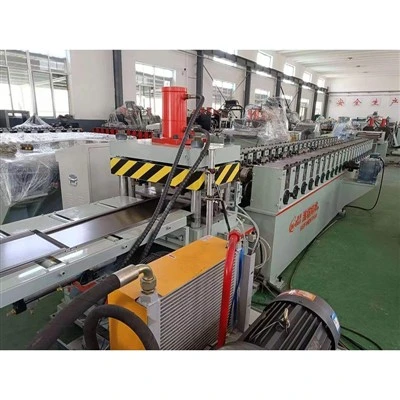
As a supplier of electrical cabinet profile lines, our job isn’t just to sell machinery—it’s to help our customers keep their teams safe, especially when the lights go out. We work with each client to build custom night-shift safety plans, tailored to their line’s layout, operator schedules, and specific hazards. We provide free annual night-shift safety training, hands-on with real line stations, and we offer 24/7 support for any safety-related questions or equipment issues.
Cable Tray Roll Forming Line If you’re tired of near-misses, scrap, or lost production due to night-shift safety gaps, we’re here to help. We’ve helped dozens of facilities reduce night-related incidents by 50% or more, while keeping production on track. Whether you’re looking to update your lighting, refine your LOTO protocols, or build a full night-shift safety plan, let’s connect to find a solution that works for your team and your business.
References
- Occupational Safety and Health Administration (OSHA). Lockout/Tagout: Protecting Workers from Unexpected Startup or Release of Hazardous Energy. 29 CFR 1910.147, 2023.
- National Institute for Occupational Safety and Health (NIOSH). Fatigue Countermeasures for Night Shift Workers. DHHS (NIOSH) Publication No. 2021-108, 2021.
- Fabricators & Manufacturers Association International (FMA). Safety Guidelines for Metal Profile Production Lines, 2022.
Weifang Yue Jun Machinery Co., Ltd.
With abundant experience, we are one of the most professional electrical cabinet profile production line manufacturers in China. We warmly welcome you to buy durable electrical cabinet profile production line made in China here from our factory. We also accept customized orders.
Address: Kuiwen District, Weifang City, Shandong Province
E-mail: adrian@yuejunmachinery.com
WebSite: https://www.yuejunmachinery.com/
