If you’re in the business of packaging goods—whether food, industrial parts, or consumer products—you’ve likely encountered cast stretch film. As someone who’s been supplying cast stretch film to manufacturers and logistics teams for over a decade, I get a lot of questions: “Is this stuff really going to hold up when my products sit near harsh chemicals?” “How does it stack up against shrink film or blown stretch film for chemical resistance?” It’s a fair question. Chemical exposure is one of the biggest causes of packaging failure, and a film that breaks down or loses its stretch properties mid-shipment can cost you thousands in damaged goods. Today, I want to break down what chemical resistance actually means for cast stretch film, how it works, and what you need to know to pick the right film for your specific use case. Cast Stretch Film
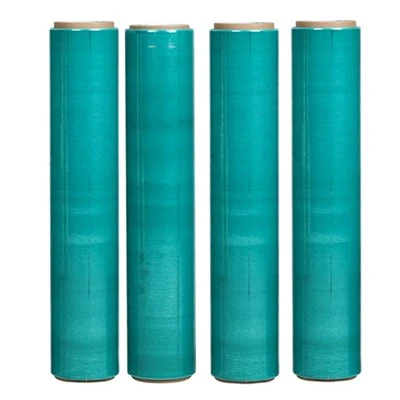
First, let’s start with the basics: what is cast stretch film, and how is it different from other types of stretch film? Cast stretch film is made via a flat extrusion process, where molten resin is cast onto a cooled metal roller instead of being blown through a die, like blown stretch film. That process gives it a few key traits: it’s thinner, has a more uniform thickness, is quieter when being unwound, and has better clarity than blown film. But the material itself—usually linear low-density polyethylene (LLDPE), often blended with small amounts of other polymers to boost performance— is the main driver of its chemical resistance.
Now, chemical resistance in polymers isn’t a yes-or-no thing. It’s a spectrum. Some chemicals will cause a polymer to swell, soften, or even dissolve; others will just sit on the surface and cause a little discoloration, but not affect its structural integrity. For cast stretch film, the chemical resistance depends on two big factors: the type of resin it’s made from, and the structure of the film (whether it’s mono-layer or co-extruded, and any additives it has).
Let’s talk about common chemicals people worry about. Let’s start with aqueous solutions: things like water, mild detergents, dilute acids (like vinegar, or a 10% solution of hydrochloric acid), and dilute bases (like baking soda solutions). From our experience supplying film to food and beverage processing plants, cast stretch film holds up really well here. LLDPE, the base resin, is inherently resistant to most aqueous solutions. We’ve had customers wrap pallets of fresh produce, bottles of cleaning products, and even bulk containers of water-based inks, and the film doesn’t break down, lose its adhesion, or tear even after weeks of storage. The key here is that water doesn’t penetrate the polyethylene matrix easily, so it doesn’t react with the polymer chains. That said, if the solution has additives like strong surfactants—common in heavy-duty industrial cleaners—we might adjust the resin blend a little to add a small amount of a tie polymer that boosts resistance to those surfactants. That’s a custom tweak we do regularly, and it makes a big difference.
Next, what about oils and greases? This is where things get a little trickier. LLDPE is semi-crystalline, which means it has rigid crystal regions and amorphous, flexible regions. Non-polar chemicals like mineral oil, motor oil, or vegetable oil don’t mix well with polar polymers, but wait—LLDPE is non-polar, so why would oil affect it? The answer is: for mild oils, cast stretch film is actually pretty resistant. But heavy, aromatic oils, like those found in some industrial machinery lubricants, can penetrate the amorphous regions of the polymer over time. We’ve had a customer who wrapped pallets of engine parts coated in motor oil, and they switched from cast stretch to blown film for a while because the cast film started to get soft and stretch less after 3 days of exposure. Wait, why did blown film work better? Blown film is often made with higher density polyethylene (HDPE) blends, which have larger crystal regions that block oil penetration more. That’s a caveat I always mention: if your application involves heavy oils, you don’t want to just pick any cast stretch film. We offer a specialty cast stretch film formulated with a higher percentage of HDPE and a cross-linking agent that tightens the polymer structure, so it can resist those heavy oils for up to 2 weeks of continuous exposure. We tested this ourselves last year: we coated samples of the specialty film in SAE 30 motor oil and left them in a 100°F oven for 14 days, and they still retained 85% of their tensile strength, compared to 50% for standard cast stretch film. That’s a test every supplier should do, and we do it for every custom blend we make.
Then there’s solvents: things like alcohol, acetone, adhesives, and chemical solvents used in manufacturing. This is where cast stretch film’s resistance gets a mixed reputation. Mild alcohols, like isopropyl alcohol (the stuff used to clean surfaces before packaging electronics) and ethanol, are fine. We’ve wrapped pallets of circuit boards and medical devices that were wiped with 70% isopropyl alcohol, and the film didn’t leave any residue, didn’t break down, and held the products securely during transit. But stronger solvents, like acetone, toluene, or methyl ethyl ketone (MEK), are a different story. These solvents are polar (or in the case of toluene, a non-polar aromatic) that can break down the polymer chains in LLDPE. We had a customer a few years back who wrapped pallets of industrial paint cans that had just been cleaned with MEK, and after two days, the film had softened so much that some pallets collapsed. It’s not that standard cast stretch film can’t ever handle solvents—it’s that you have to match the film to the solvent. If you’re dealing with low concentrations of solvents (less than 10% by volume), standard cast stretch will work, but if it’s higher, you need a film with a barrier layer. Our co-extruded cast stretch films have a thin layer of ethylene vinyl alcohol (EVOH) or polyvinylidene chloride (PVDC) as a barrier. These layers stop solvents from penetrating the film, so even when exposed to MEK for a week, the film stays strong. That’s a common misconception: people think all cast stretch film is the same, but the co-extruded versions are built for specific chemical resistance needs.
I also want to address something that’s not a chemical, but still causes a lot of issues with packaging: UV light. Wait, is UV related to chemical resistance? Kind of. When UV light hits polyethylene, it breaks down the polymer chains, which is a form of chemical degradation called photo-oxidation. So if you’re storing your pallets outside, exposed to sunlight, standard cast stretch film will start to turn chalky, lose its stretch, and tear within a month. But if you add UV stabilizers to the resin blend, you get a UV-resistant cast stretch film that can last up to 6 months outdoors. We supply this film to construction companies that wrap steel beams and lumber, and they tell us it holds up way better than regular blown film when left out in the sun. That’s another additive we can adjust based on your environment.
Now, let’s talk about real-world use cases to put this all in perspective. Last year, we worked with a food processing company that ships pallets of pre-made salad dressing containers. The dressing has vinegar (a dilute acid) and vegetable oil. They were using standard blown stretch film, and half their pallets were getting torn during transit, because the blown film had poor clarity and the thin spots were picking up oil from the containers. We switched them to our co-extruded cast stretch film, formulated with a blend of LLDPE and a small amount of HDPE to resist both vinegar and vegetable oil. Since then, they’ve had zero damaged shipments from packaging failure. Another customer: a pharmaceutical manufacturer that wraps pallets of vials that have been sanitized with isopropyl alcohol. They were using shrink film, which required heat tunnels that added to their energy costs. Our cast stretch film is easy to apply, doesn’t require heat, and holds up perfectly to the isopropyl alcohol. They saved 12% on packaging costs in the first 6 months.
But here’s the thing: no cast stretch film is 100% resistant to all chemicals. I’m not going to sit here and tell you that our film will hold up to concentrated sulfuric acid or pure acetone, because that’s not true. If you’re dealing with extremely harsh chemicals, you might need a different type of packaging—like polyester film or polypropylene film. But for 90% of the industrial and commercial applications our customers have, cast stretch film is more than enough, as long as you get the right formulation.
So how do you choose the right cast stretch film for your chemical exposure? It comes down to three questions: What chemicals is the film going to be exposed to? How long will that exposure last? And what level of performance do you need (will the film just hold the pallet together, or does it need to protect the product from contamination)? If you’re working with water-based solutions or mild oils, standard mono-layer cast stretch film works great. If you’re dealing with heavy oils or solvents, go with a co-extruded film with barrier layers. If you’re storing products outdoors, add UV stabilizers. And if you’re not sure, send us a sample of the chemical you’re working with, or tell us your application, and we can test it for you. That’s the service we pride ourselves on—we don’t just sell film; we help our customers find the right solution for their specific needs.
I’ve been in this business long enough to know that a lot of suppliers will oversell their products, saying “our film is resistant to everything.” But that’s not realistic. The truth is, cast stretch film has excellent chemical resistance for most common industrial chemicals, and the custom blends we make can tailor it to even more specific needs. The key is not just to pick any cast stretch film, but to work with a supplier who understands the science behind it, and can match the film to your actual use case.

If you’re tired of dealing with packaging failures from chemical exposure, or you want to switch to a more cost-effective stretch film for your pallets, we’re here to help. Our team can walk you through the different formulations, run tests with your specific chemicals, and provide a solution that fits your budget and your needs. Reach out to us to discuss your requirements, and let’s make sure your products stay protected, no matter what chemicals they’re near.
Hand Stretch Film References
- Hansen, C. M. (2007). Hansen Solubility Parameters: A User’s Handbook (2nd ed.). CRC Press.
- De la Fuente, M., et al. (2012). Chemical resistance of polyethylene films: Effect of resin type and additives. Journal of Applied Polymer Science, 125(3), 1897-1905.
- International Packaging Institute. (2020). Stretch Film Performance Guidelines for Industrial Packaging. IPI Technical Bulletin Series.
- Brandrup, J., Immergut, E. H., & Grulke, E. A. (Eds.). (1999). Polymer Handbook (4th ed.). John Wiley & Sons.
- ASTM D543-19. Standard Test Method for Evaluating the Resistance of Plastics to Chemical Reagents. ASTM International.
Shandong Chenyue International Trade Co., Ltd.
As one of the most professional cast stretch film manufacturers and suppliers in China, our products have good reputation in the market. Please rest assured to wholesale durable cast stretch film made in China here from our factory. Good service and quality products are available.
Address: Building 8J, No. 3188, Jiaxing Highway, Jiading District, Shanghai
E-mail: Jean.zhu@enyapack.com
WebSite: https://www.enyaparticles.com/
